
Your donor gave last year. They attended your gala in the spring. They opened every email in your year-end campaign. But when your major gifts officer sat down to make the call, they had no idea.
That information existed. It just lived in three different places, and no one had time to connect the dots.
This is the real cost of a disconnected CRM. Not just messy data. Missed relationships.
A nonprofit CRM is often treated like a contact database: a place to store names, addresses, and giving history. But when it is working well, it does something more important. It gives every person on your team a complete, current picture of each donor, so that every interaction can build on what came before.
The best donor management setup does two things well.
It gives your team a full view of every supporter, across every touchpoint, without manual effort.
And it makes the right next action obvious, whether that is a thank-you, a renewal ask, a major gift conversation, or just checking in.
Here is what that looks like in practice.
1. Every Donor Interaction Should Flow Into One Profile Automatically
When a donor gives online, registers for an event, joins a peer-to-peer campaign, or bids at an auction, that activity should land in their donor record without anyone having to move it there.
Most teams do not have this. They have a donation platform, a separate event tool, a spreadsheet for peer-to-peer fundraisers, and a CRM that is perpetually behind. Someone has to reconcile all of it. Usually that person is the same one who should be building donor relationships.
Automated data capture is the foundation. When every action ties to the right profile in real time, your donor records actually reflect what is happening. And your team can spend their time on donors instead of data.
2. Duplicate Records Are a Bigger Problem Than Most Teams Realize
Duplicate records are not just a tidiness issue. They mean you might be sending the same donor two separate acknowledgments, two separate renewal appeals, or two separate solicitations with different ask amounts. That erodes trust quickly.
They also mean your retention rates, lifetime value numbers, and lapsed donor reports are wrong. When you are making decisions based on those reports, bad data produces bad decisions.
With CauseVox’s AI powered de-duplication, the platform automatically identifies and flags records that appear to be the same donor, whether the match is an exact email address or a fuzzy match on name and mailing address. You can review and merge those records in a few clicks, so your donor database reflects reality instead of accumulated data entry errors.
The result is cleaner reports, more accurate retention numbers, and appeals that reach each donor once, with the right ask, at the right time.
3. Donor Profiles Should Show Relationships, Not Just Records
A donor’s profile should tell you more than what they gave. It should show you who they are connected to: whether they share a household with another donor, whether they represent a corporate partner, whether they were the one who recruited three other donors through a peer-to-peer campaign.
That relational context changes how you steward people. A peer-to-peer fundraiser who raised $4,000 for you deserves a different conversation than a one-time $50 donor, even if their direct giving looks similar on paper.
Soft credits and connected entities let your team track influence and relationships alongside giving history, so stewardship decisions are grounded in the full picture, not just the transaction record.
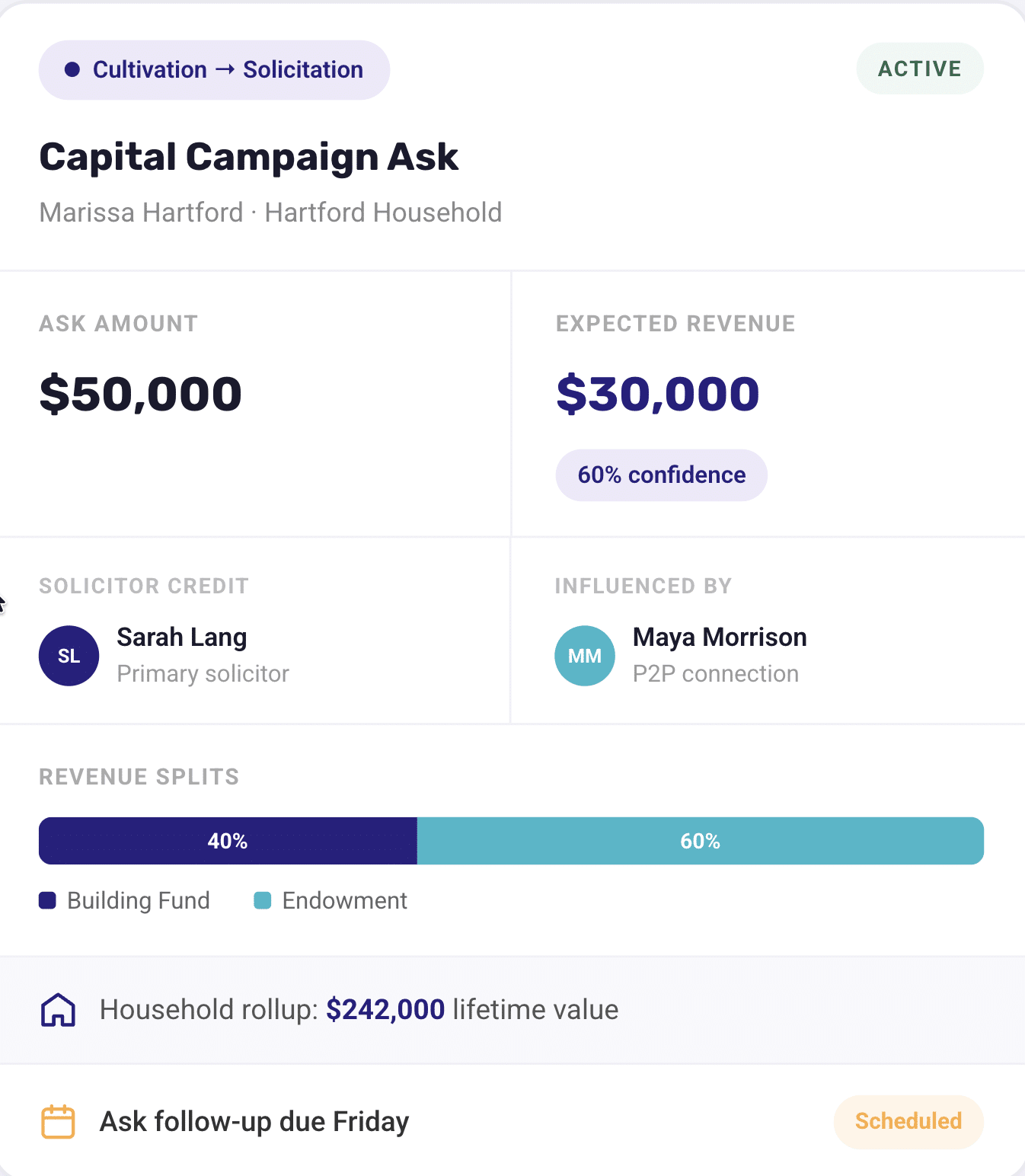
CauseVox’s CRM makes it easy to see the whole picture of your donor relationships.
4. Stewardship Needs a System, Not Just Good Intentions
Most nonprofit teams want to do great donor stewardship. The problem is that it depends on individuals remembering to follow up, knowing what to say, and finding time in between everything else.
When stewardship is organized through a CRM with pipeline management, portfolio views, task assignments, and reminders, it becomes a repeatable process instead of an improvised one. You can see which donors are in which stage of the relationship, who has not heard from you in a while, and what your team’s next steps are for each major gift prospect.
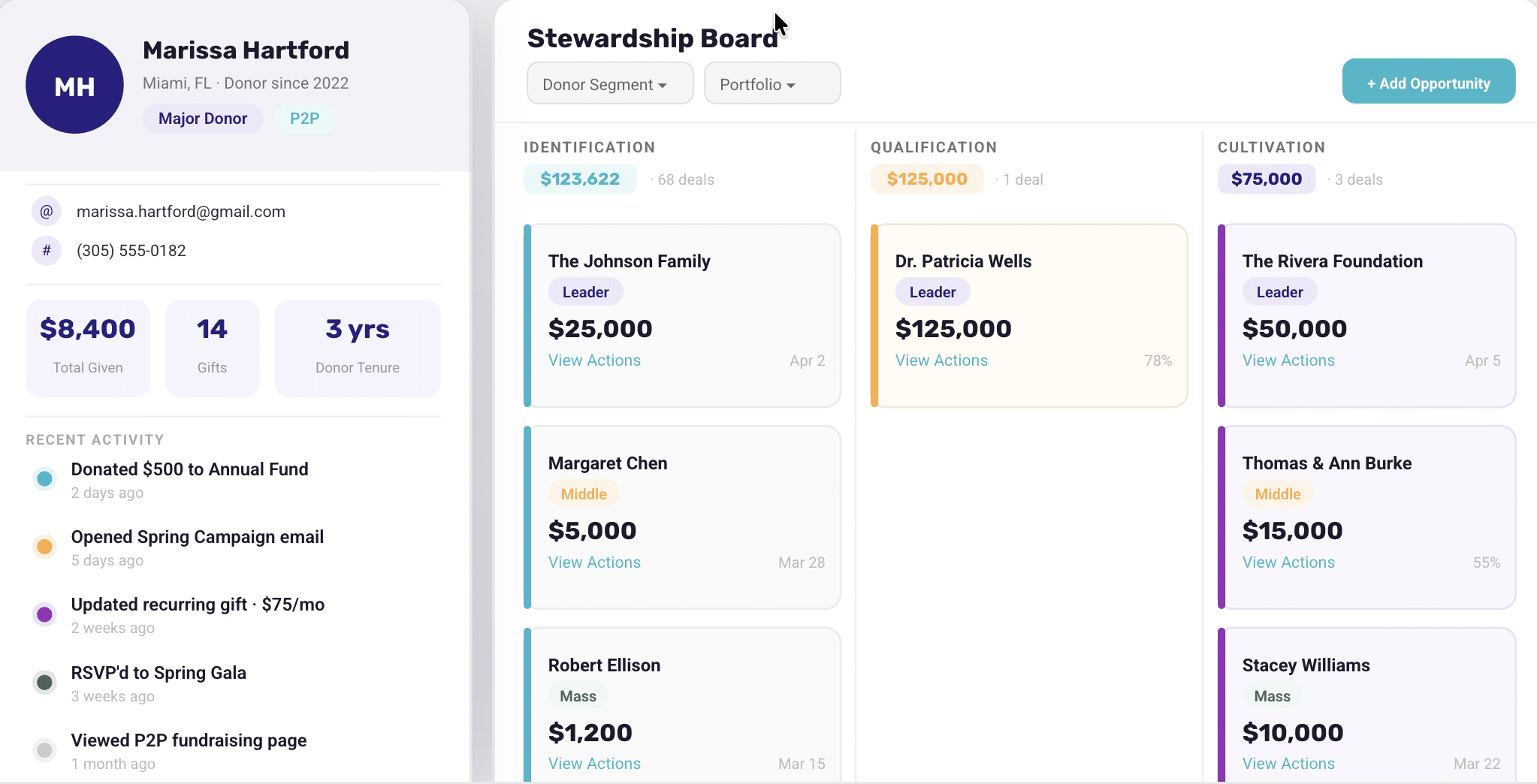
CauseVox’s CRM has built in pipeline and stewardship tools
Pipeline management is not just for major gifts teams. Any team can benefit from a clear view of where their most important donor relationships stand and what needs to happen next.
5. Gift Tagging and Coding Keep Your Reporting Clean From the Start
One of the most common reporting headaches in nonprofit finance is trying to reconcile online donations that were not properly coded at the time of entry. Someone has to go back, match transactions to funds, campaigns, or appeals, and hope that nothing was missed.
When gifts are tagged with fund designations, campaign codes, and appeal labels at the point of entry, whether they come in online or are entered in bulk offline, your records are reporting-ready from the start. You do not need to clean them up before sending a report to the board or a grant funder.
Bulk batch entry for offline gifts, pledges, and check donations matters here too. Those gifts need to be in the system quickly and tied to the right profiles, not sitting in an inbox waiting to be manually entered one by one.
6. Your CRM Should Make Outreach Easier, Not Require More Tools
If your team has to export a segment of donors to a separate email platform, send the message, then manually update the CRM with engagement data, you are losing context at every step.
Integrated email and SMS communications let your team reach donors directly from the platform where their records live. The communication history stays attached to the donor profile, so anyone on the team can see what was sent, when, and how the donor responded.

Email and SMS communications are built into the CauseVox CRM allowing you to steward donors and send updates in one seamless tool.
This matters most for stewardship touchpoints: quick thank-yous, event reminders, mid-year updates, and personal notes to major gift prospects. When those communications are connected to donor records, they inform the next conversation instead of disappearing into a separate inbox.
7. Reporting Should Answer Real Questions Without a Data Export
How many donors gave last year but not this year? Which campaign brought in the most new donors? What is the average gift size for donors who also attended an event?
These are not exotic questions. They are the questions every fundraising team needs to answer regularly. But if getting the answer requires a custom export, a spreadsheet formula, and 45 minutes, most teams stop asking.
Template reports for LYBUNT, SYBUNT, donor retention, and campaign performance give teams a starting point without building from scratch. A query builder that spans donations, registrations, and peer-to-peer activity lets you go deeper when you need to.
AI-powered reports that respond to plain-language questions like “who are my most engaged new donors this year?” make analysis accessible to the whole team, not just whoever knows how to build a pivot table.
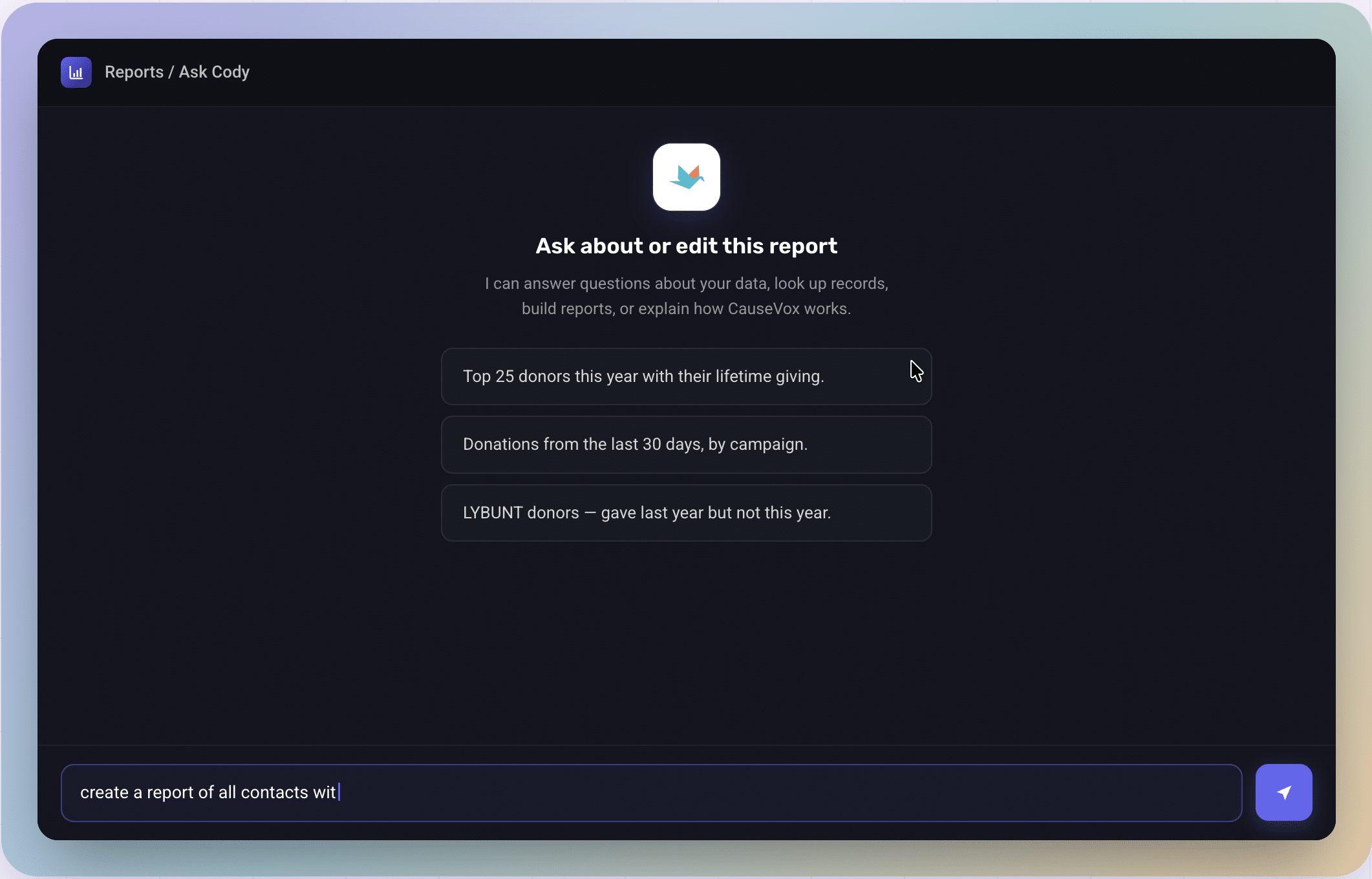
CauseVox’s AI runs on the connected donor record, one question can reach across all your data without a data analyst.
8. Donors Should Be Able to Manage Their Own Information
Self-service donor portals reduce administrative load significantly. When donors can update their own contact information, modify a recurring gift, change a payment method, or view their giving history without emailing your team, that is time your staff gets back.
It also creates a better donor experience. A supporter who can easily manage their relationship with you on their own terms feels more in control and more connected. That is especially true for recurring donors, whose long-term value depends on the sustainability of that ongoing relationship.
Common CRM Mistakes to Avoid
Even dedicated nonprofit teams can end up with a CRM that creates more work than it saves. Watch out for:
- Keeping your CRM separate from your fundraising platform, which means every campaign requires manual reconciliation after the fact
- Relying on individuals to remember follow-up tasks instead of building stewardship into a structured pipeline
- Letting duplicate records accumulate until they require a large cleanup project rather than addressing them continuously
- Entering gifts without fund, campaign, or appeal tags, then trying to reconstruct that context at reporting time
- Using a separate email or SMS tool that does not connect communication history back to donor profiles
- Treating the CRM as a historical archive rather than an active tool your team uses to plan and prioritize their week
These problems usually are not caused by a lack of effort. They happen when your tools, data, and follow-up are not working together.
How to Use A Nonprofit CRM to Manage Donor Relationships Better
A good CRM should help your team see the full picture of every supporter, stay on top of follow-up without relying on memory, and have more confident conversations with donors because they know the history. It should do that without adding manual work or requiring a data cleanup sprint every quarter.
That is where connected fundraising matters. When your fundraising activity and donor management live in the same platform, your data stays accurate, your team stays aligned, and your donors feel known.
With CauseVox Free, you get a built-in CRM that updates itself every time a donation comes in, a campaign goes live, or a message goes out. No imports. No reconciling. No extra cost. Just a clean, connected record of every supporter so your team can spend less time managing data and more time building the relationships that actually drive revenue.