

Your donation form should be helping you get more donors, whether it’s on your website, or on your crowdfunding page, or your peer-to-peer fundraising campaign.
To make sure you’re getting as many donors as possible, your focus should be on increasing your donation form conversion rate, which is the percentage of people who actually complete a donation once they’ve landed on your site. How easy it is to give makes a big difference: if your donation form is too long, too confusing, or not mobile-friendly, many potential donors will navigate away.
However, when your donation form makes it as easy as possible to give, you can actually raise up to 2x as much, without any additional asks. For example, CauseVox users typically raise 82% more when they switch from a generic donation form, to a custom one helping organizations raise nearly 2x as much through their website.
A significant part of driving conversions on your donation form has to do with your suggested levels of giving, aka your donation tiers. The average gift sizes on CauseVox generally range between $78 and $109, with higher averages often driven by the use of impact-driven donation tiers and peer-to-peer campaigns.
Optimizing your conversion rate and average gift size isn’t just a nice-to-have. It’s the difference between your organization growing and your organization barely scraping by.
Here’s how you can use donation tiers to increase your donor conversion rate and drive up gift size.
How Donation Tiers Drive Donor Conversion
One of the simplest ways to grow your donor base? Give people a clear path to follow.
When donors land on your giving page and see a well-thought-out set of donation tiers, something clicks. Instead of wondering what to give, they’re choosing which level feels right for them. By anchoring each amount to a concrete impact you remove the guesswork and make the decision feel meaningful rather than arbitrary.
With some careful social science, you can use your donation tiers to subtly signal to your donors how much you really want them to give. This can increase gifts overall. Let’s take a look at how you can use your donation tiers to increase giving.
5 Top Tips for Donation Tiers To Convert More Donors
1. Don’t Offer Too Many Options
One of the benefits of donation tiers is that it minimizes the number of decisions the donor has to make, removing the friction that comes with making a decision of how much they should give.
If you have a big list of 10 different options, the decision making process becomes longer. They have to think, should I give $15, or $25, or $35, or $50?
For most people, it’s likely that someone that could afford to give $15 could also easily give $25. If you have both options, it’s just unnecessary clutter. If you only provide a $25 tier, you can pull some of those $15 donors up, and allow all donors to quickly find the amount that works for them.
At CauseVox, we’ve found that the optimal donation experience has between 3-6 donation tiers. Any more, and your donor will feel overwhelmed by the number of choices they should make. And, if you use descriptive tiers (ie: $10 feeds one child a day): they should be short and easy to digest.
4 purposeful, impact driven donation tiers on a CauseVox campaign
Especially if you know folks will be giving on mobile (as we’ve seen 65% of them do), you want the form to be as short and simple as possible. One great option for mobile giving is to use CauseVox’s compact tiers.
Compact tiers give you:
- A shorter form, no descriptions required!
- Enhanced UI for the easiest donor experience, especially on mobile devices.
- Flexible tier options so you can tailor your donation page for your needs.
- A faster, simplified process so you get more donors completing their donation.
With shorter and simpler donation tiers, you remove friction, and therefore help them get onto the next step faster.
2. Tailor It To Your Needs
Each nonprofit is different, and any good donation page is customized to your needs.
Maybe compact tiers are the right choice for you, but you may also want to tell your donors a little bit about what each amount will do.
According to Nonprofit Pro’s recent trust research, people have more confidence in local nonprofits and community organizations than in large national institutions, making it more important than ever that your donors can see exactly where their money is going. Descriptive tiers are a bite-sized way to provide that clarity.
This can give some donors the final push to make a donation. You can use descriptive tiers to share specifically about the impact of a donation at each giving level.
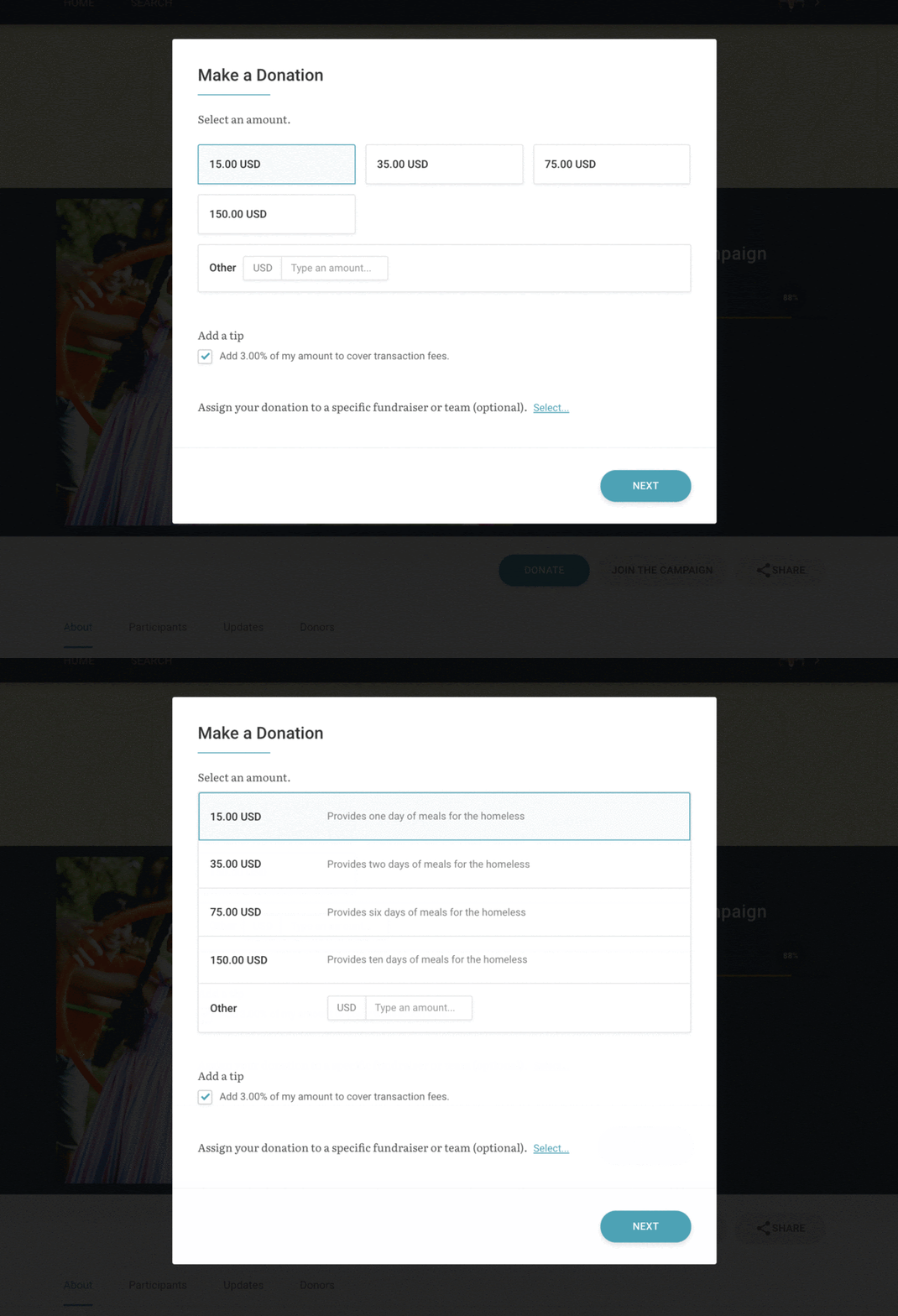
Compact tiers vs. descriptive tiers on CauseVox
There are so many ways to describe impact. Possibilities include:
- Person to person – $25 gives one student access to an after-school tutor for a week
- Item based – $40 stocks a hygiene kit with everything a shelter resident needs for a month
- Time based – $50 funds one hour of legal aid for a family navigating the immigration system
- Recognition and rewards – $20 unlocks our quarterly insider newsletter and a handwritten thank-you from our team
- Titles – $30 makes you a Community Builder, $75 makes you a Change Maker
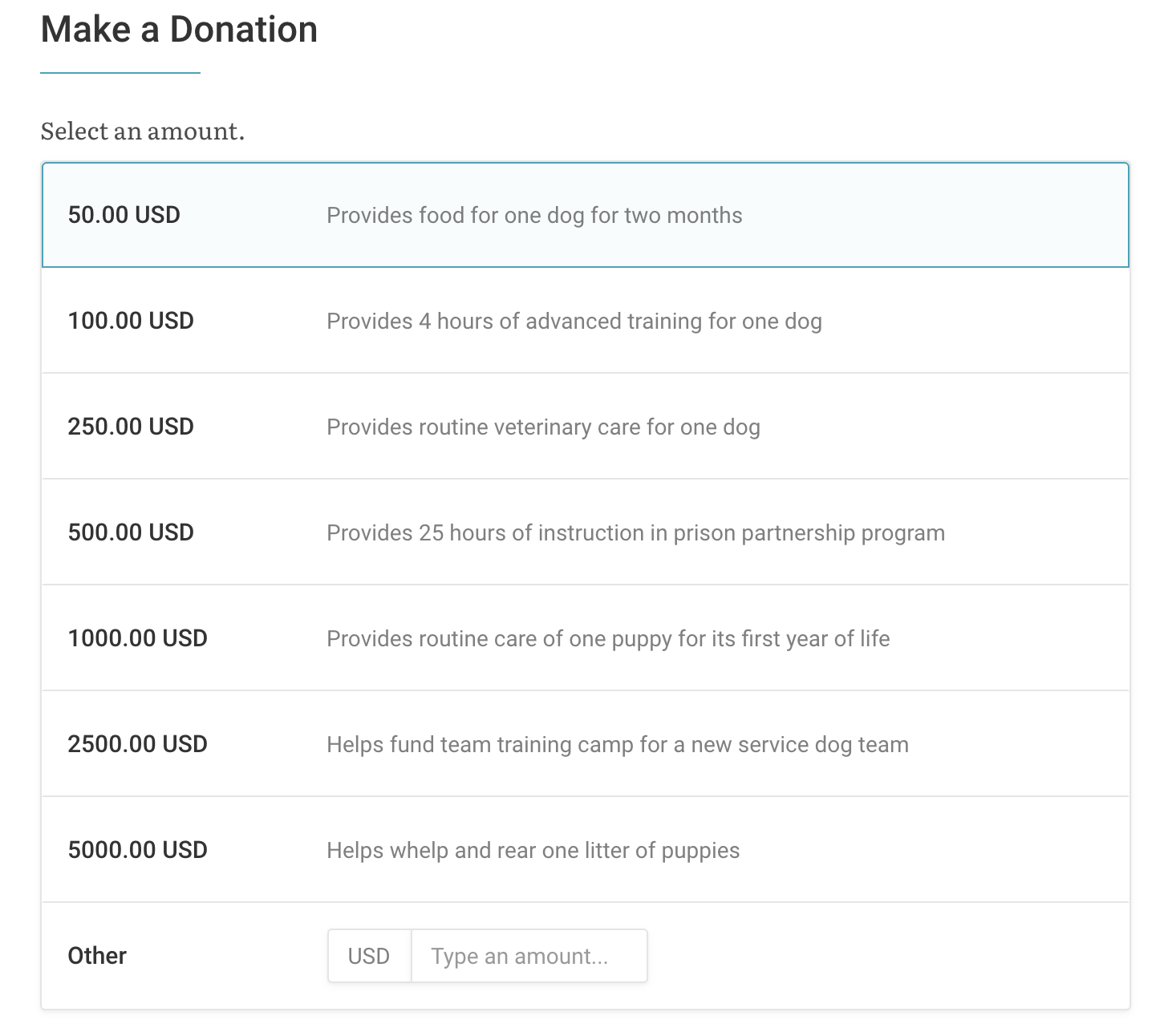
Summit Assistance Dogs uses impact-driven tiers
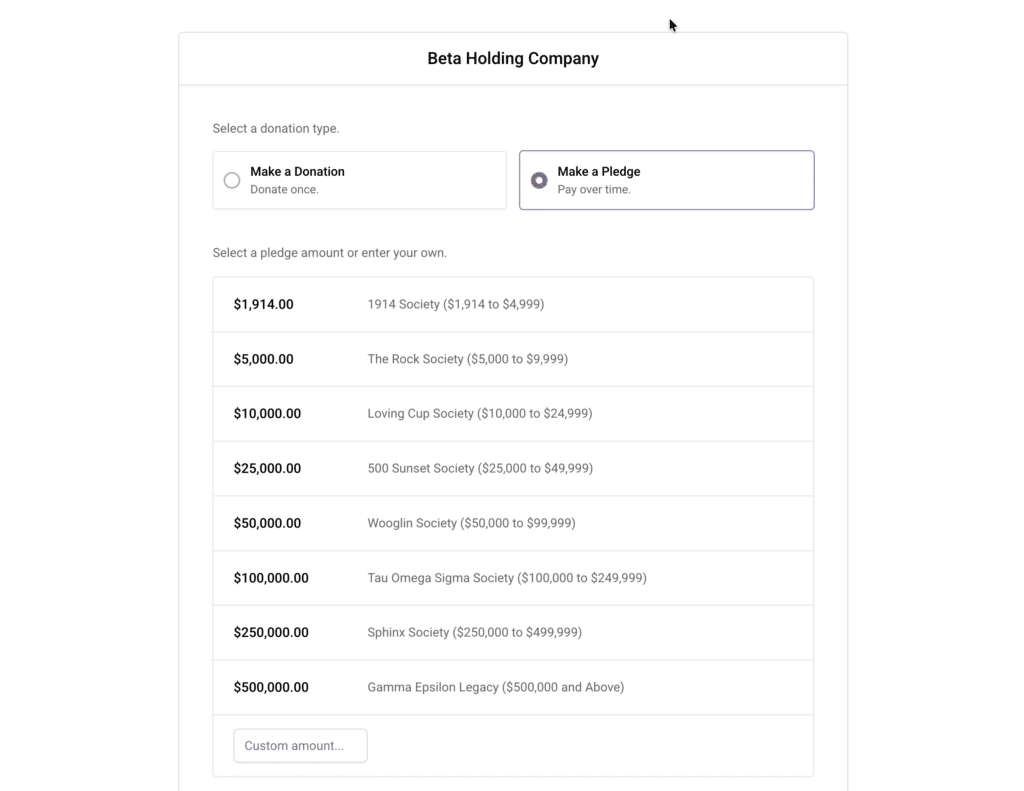
Title-based donation tiers with CauseVox
What’s really important here is knowing your organization and your donors.
Maybe you don’t have a clear description (ie: $20 or $50 both go towards cancer research), or you know your donors are ready to give by the time they hit your donation page. If you want a short and clean process, stick with compact tiers. But if you want your donor to see the impact of every donation amount, descriptive tiers may be right for you.
3. Customize Your One-Time Donation Tiers For Your Audience
Ready to build tiers that work for your audience? Start by looking at your average gift size.
When you pull the average gift size, including the median gift size, you’ll have a great jumping off point to help you create your list of 3-6 customized tiers that fit your own audience.
Better yet, take a look at your existing median gift amount, and start moving it up a bit to help push donors to give more.
Is your median gift $50? Instead list $55 as your donation tier.
If you don’t know where to start, the average donation on CauseVox is about $78. If we were to create a site-wide set of donation tiers, we’d start by building one right at about $75. Next, we’d fill in one below and one above, and add in at least one that’s over double.
4. Customize Your Recurring Donation Tiers
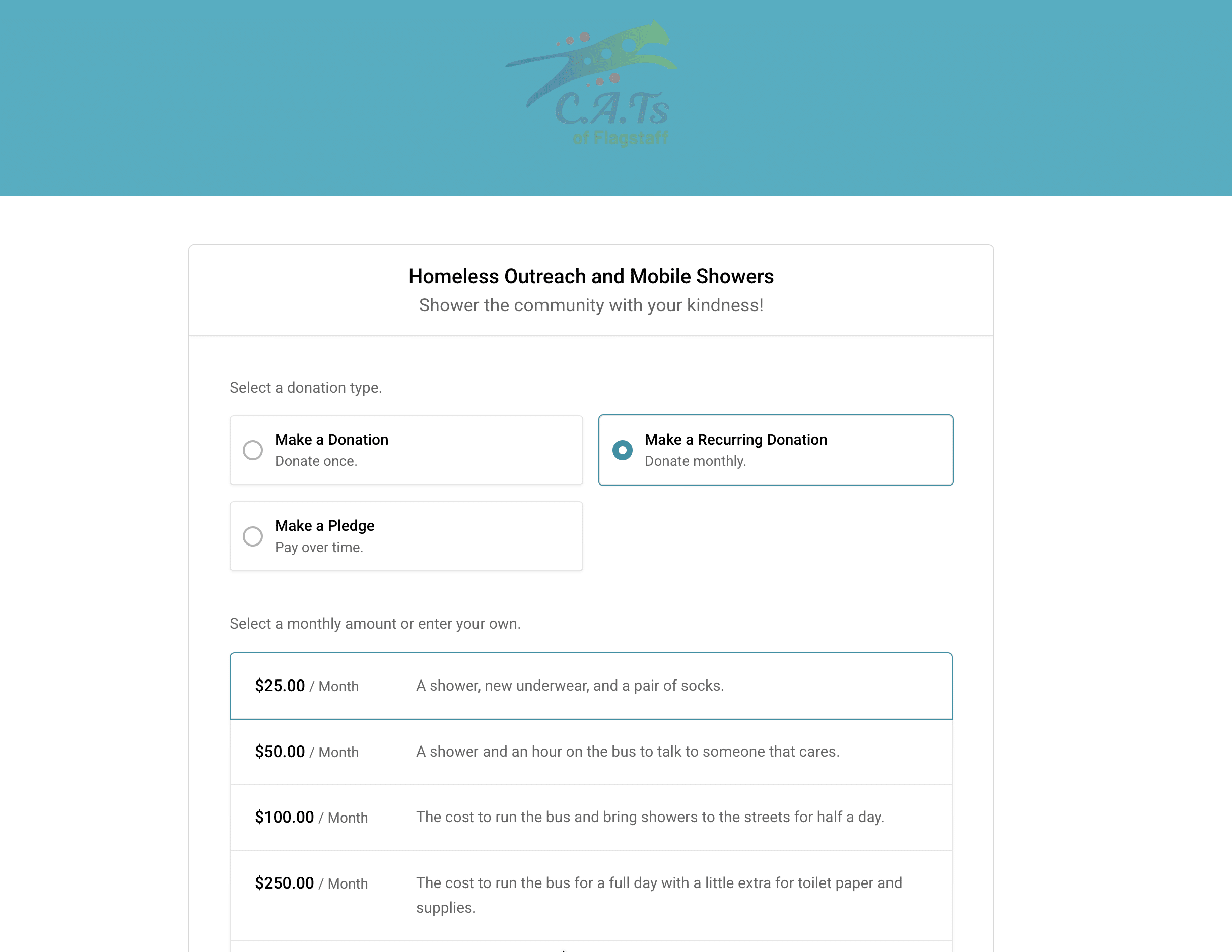
You can take it one step further by customizing recurring donation tiers to increase giving.
Recurring donors typically give 42% more over the course of a year, and have a 90% donor retention rate. This means that your recurring donors give nearly twice as much, and stick around for longer.
To maximize recurring giving, you’ll want to create customized donation tiers that help drive more recurring gifts.
Let’s say your first one-time donation tier is $30, but your first recurring donation tier is $10. Sally comes to your page, initially thinking to give a $30 one-time donation. But instead, she also sees the option to give $10/mo to provide ongoing support. It’s less money out of her pocket in the moment, and she’s excited about what you’re doing, so it’s a nice alternative.
Sally chooses the $10 option, and you’ve just increased Sally’s gift size 4x times over the course of a year, with no more effort on Sally or your organization’s part.
You can segment out your recurring donor average/median gift amounts, and use recurring donation tiers to drive up recurring gifts too. With CauseVox’s built-in CRM, you can take that a step further, filtering donors by giving history and frequency to send targeted upgrade asks to exactly the right people at the right time. Instead of blasting your whole list, you’re reaching out to your $25/month donors with a personalized nudge toward the $40 tier, making the ask feel thoughtful rather than transactional.
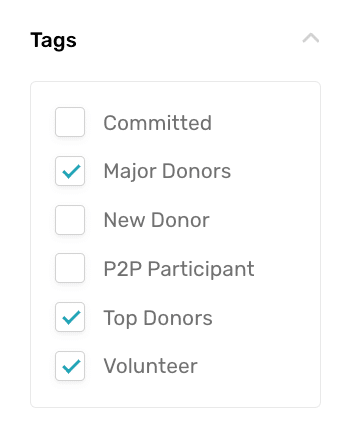
Easily tag and segment donors on CauseVox’s CRM
Pro-tip: If you want more recurring donors, make sure “monthly recurring” is your default, so it’s the first option your donor sees.

One-time and monthly recurring donation tiers on CauseVox Donation Page
4. Use Multiple Pages For Different Audiences, With Custom Tiers
The same set of donation tiers isn’t going to make sense everywhere. If you’re running a high-end gala with your top donors, you’ll want a set of donation tiers that matches the depth of their pockets. If you’re running a school fundraiser with local parents, you want amounts that will feel accessible to everyone.
This might mean creating different pages or campaigns to be used in different settings. Segment your donors based on the data you have about them, and provide each segment with tiers that fit in their budget.
The same logic applies to pledge campaigns, if you’re asking donors to commit to a gift over time, your tiers should reflect realistic installment amounts rather than a lump sum that feels out of reach. A donor who hesitates at a $5,000 ask might gladly commit to $500 a month over 10 months, so building pledge-friendly tiers into your campaign pages can open the door to major gift-level commitments without the sticker shock.
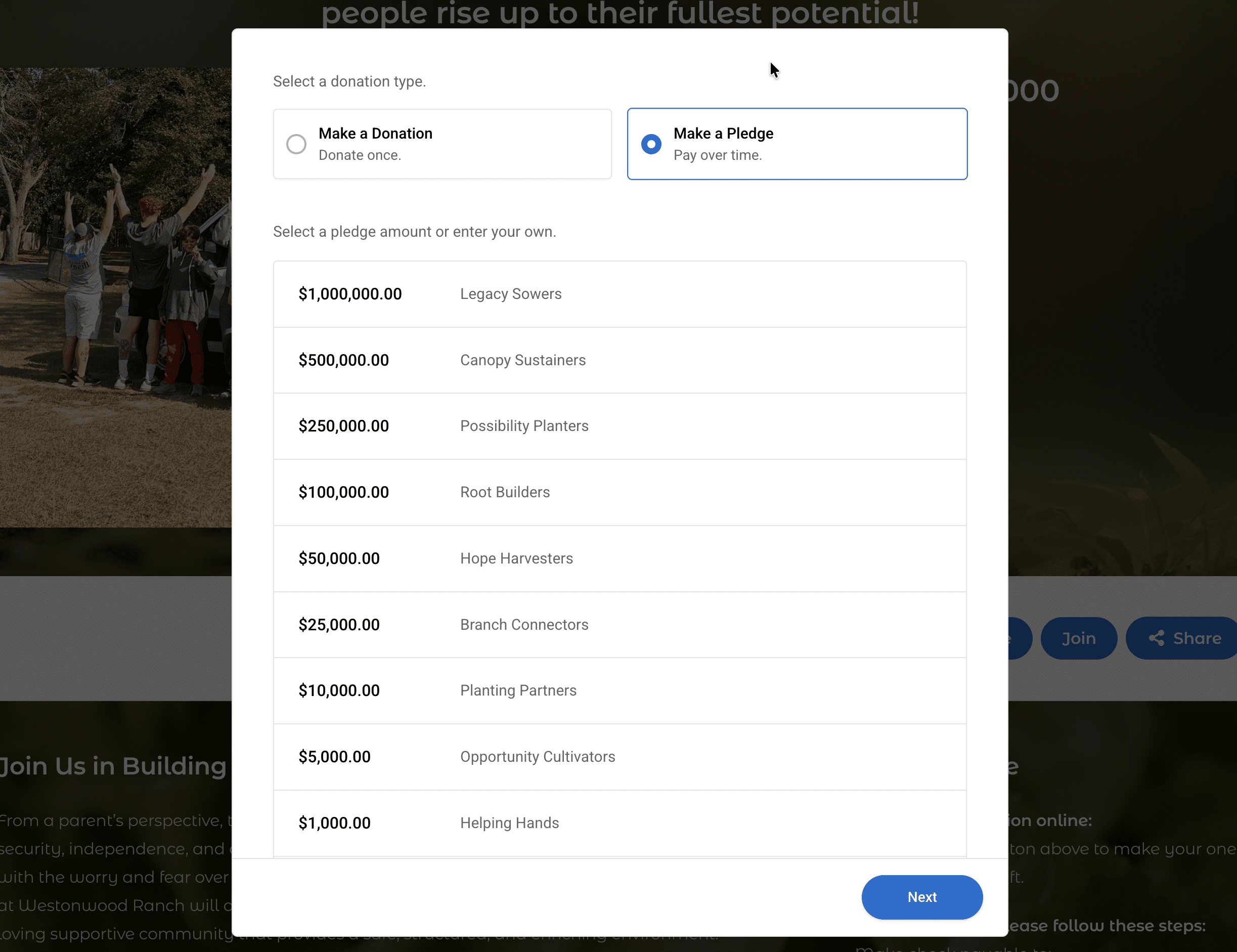
Donation tiers for pledge donations with CauseVox
5. Think Design
When restaurants create their menus, they often use principles of design to push diners to certain items. You can do the same with your donation tiers. For example, out of all the donation tiers, most people will choose the second option on the list.
This little factoid relies on a quirk of human psychology: we don’t want to spend too much, but we don’t want to seem like we’re giving the least. If there’s one amount that you really want your donors to give, place it second.
Another trick is called anchoring. You’ve probably seen some donation pages that have one amount highlighted. This makes that number seem more important than the others on the page, and will pull donors to give that amount.
CauseVox builds these design principles into our donation form, helping you create tiers that match your needs.
Raise More With Free Customized Donation Forms
Your donors are already out there; they just need a clear, compelling reason to commit. Donation tiers give them that reason, and with CauseVox, setting them up takes minutes, not days.
The best part? It’s completely free to get started.
Are you ready to raise more with less effort? Schedule a demo today.